

Jordan: A Journey Through History, Culture and Millennial Wonders
Jordan has always been on my bucket list. As a child, it was for me the place of one of the Seven Wonders of the World, Petra, but little by little I learnt that this land offered much more.
Despite being an Islamic country, its historical-archaeological heritage includes a legacy left by Romans, Crusaders, Jews and Christians, while its natural heritage includes the famous Dead Sea, the Red Sea and the Wadi Rum desert.
Jordan is a set of emotions, a mix of cultures, smells and tastes. A place where there is no shortage of adventure and the landscape always leaves you breathless.
Having the opportunity to visit Jordan independently (we relied on a private driver) allowed us to visit the places we chose and according to our schedule.
Each place visited contained a story, even that History that is studied in books.
Amman and Jordanian Culture
Jordan has two international airports, one in Aqaba, in the south of the country and perfect for those who want to dedicate themselves to the Red Sea, for example, and one in Amman, the capital, which is located to the north. We landed on the latter.
Amman is a city that blends modernity and tradition. The streets of the Citadel tell the story of the Roman past, with the Temple of Hercules and the Roman Theatre. In the centre, there are historic cafes where you can breathe the scent of cardamom mixed with Arab coffee, while in the souks, markets, the call of spices and colourful fabrics invites travellers to let themselves be absorbed by the local culture. Amman abounds with traditional restaurants but also modern bistros. I always opt for the former.
I recommend dedicating at least 2 full days to Amman, especially if you intend to visit some museums. The Archaeological Museum, for example, houses some of the Dead Sea Scrolls.
Jerash: A tresure left by Romans
North of Amman, an hour away, is the city of Jerash, nicknamed the Pompeii of the East. Here, we find one of the best-preserved Roman archaeological sites in the world.
The visit begins from the imposing Arch of Hadrian, which allows you to imagine the grandeur and beauty of the site. From there, you can stroll through cobbled streets, imposing temples, well-preserved theatres and the majestic Oval Forum, surrounded by an elegant colonnade.
In the city’s ancient main street, the Cardo Massimo, you can still observe the furrows left by Roman-era wagons.
The Jerash site is kept alive; in fact, the South Theatre is still used for shows and concerts thanks to its surprising acoustics.
Visiting Jerash takes half a day, and from Amman, there are regularly organised excursions, including from hotels, and back to the capital.
Madaba: The City of Mosaics
South of Amman, there is the city of Madaba, famous for the extraordinary mosaic tradition witnessed by the famous “Map of Madaba”, a 6th-century Byzantine mosaic preserved in the Church of St. George. This masterpiece represents the Holy Land with a unique cartographic precision, revealing itself as a precious historical testimony.
In addition to the Madaba Map, the city is home to numerous other mosaics of equal beauty scattered among churches and archaeological sites. It is worth visiting the Madaba Archaeological Park, where there are remains of ancient Byzantine and Roman churches, as well as the Church of the Apostles, which houses a magnificent mosaic depicting Thalassa, the female personification of the sea, surrounded by fishes and sea creatures, flowers, fruits and angelic faces.
Madaba too does not take much time, indeed, a couple of hours are more than enough, so once you visit the main sites you can leave for other places.
On the same day, my itinerary took us to places particularly felt by believers. Unmissable places for those taking a trip to the Holy Land.
Biblical Jordan: In the Footsteps of Faith
Jordan also holds places of profound religious significance. There are two sites of most interest. Mount Nebo, the place from which Moses saw the Promised Land, offers a breathtaking view of the Jordan Valley, and Bethany beyond the Jordan, which is recognised as the place of Jesus’ baptism, a site of great importance for pilgrims from all over the world.
On Mount Nebo, once through the entrance, you can freely walk, visiting the garden and the church. In Bethany beyond the Jordan, it is mandatory to be accompanied and take part in a tour. In fact, when we arrived at the ticket office, we waited about ten minutes for the tour to start. With a shuttle, we headed to the place of interest. We walked along a dusty road, with solitary churches scattered in the barren landscape.
The main reason that obliges the accompaniment of visitors is that Bethany beyond the Jordan is located on the border line with the West Bank. Beyond the river, you can see the Israeli flag and armed soldiers.
The Jordan River has changed a lot over the centuries, both for geological reasons and because of heavy human interventions (construction of catchment basins and diversion of the river), reducing its flow and reducing it to a mere river. The site and route are quite neat and clean. There is also a church that you can visit, but nothing extraordinary. For me, the visit to the baptismal site was worth it, especially for its religious significance. The place is quiet and conveys serenity, but the expectations Vs reality may not coincide.
Once we finished our visit to Bethany across the Jordan, we headed south. Our destination was Wadi Mujib.
Wadi Mujib: The Grand Canyon of Jordan
The Mujib Biosphere Reserve is the lowest nature reserve in the world. It is a spectacular reserve with a unique biodiversity: water that flows all year round, fed by seven tributaries, a difference in altitude that goes from 410 m below sea level to 900 m above sea level. Mountains, valleys and cliffs make it perfect for many species of wild animals as well as hundreds of species of plants.
In terms of activity, the Wadi Mujib offers trekking, hiking, an adrenaline-pumping zip line and canyoning between sinuous rock walls, which are tinged with colours ranging from grey to orange, contrasting with the blue of the water that leads to refreshing waterfalls.
The Wadi Mujib, thanks to its geographical characteristics, offers different trails depending on the preference of the landscape, the timing, the activities to be done and the ease of the route. Some of them require the presence of a guide. Some trails in the winter are closed for safety reasons, so my advice is to find out what you want to do and then contact the Visitor Centre.
We opted for the Siq Trail, which is short, rewarding and easily accessible in total autonomy. With its narrow gorges and natural pools, it offers strong emotions and beautiful views. Despite the challenge of crossing the river and its countercurrent waterfalls, it was still relaxing to immerse yourself in nature.
I would love to go back there to be able to do the other trails as well. So yes, if you are an adventure lover like me, the Wadi Mujib Biosphere Reserve deserves and is a must.
Il giorno seguente, con calma, abbiamo lasciato il Wadi Mujib e ci siamo diretti verso il Wadi Musa alla scoperta di Petra.
Wadi Musa and Petra: The Pink City of the Desert
Leaving the adventure behind, we headed towards the Wadi Musa. The distance is 2 hours and 45 minutes, although we took longer. In fact, we got lost due to a lack of signage. Our driver relied on Google Maps, but being close to the Israeli border, there was interference and the signal was interrupted. Fortunately, our driver was Jordanian and had no problem asking for information. However, this is not an insurmountable problem, I know of many travellers who have driven to Jordan on their own, just have a road map or offline maps.
We had crossed an arid landscape, where there was only one road and a few dry bushes, and we crossed paths with a goat herder and occasionally some other off-roaders.
Before leaving, I contacted a Bedouin guide with whom we would meet in Uum Sayhoun, the Bedouin village built by the government. Generally, tourists stay in Wadi Musa, but to support the already precarious Bedouin economy, I decided to rely on this guide who would accompany us around and let us stay in a cave near a small ravine.
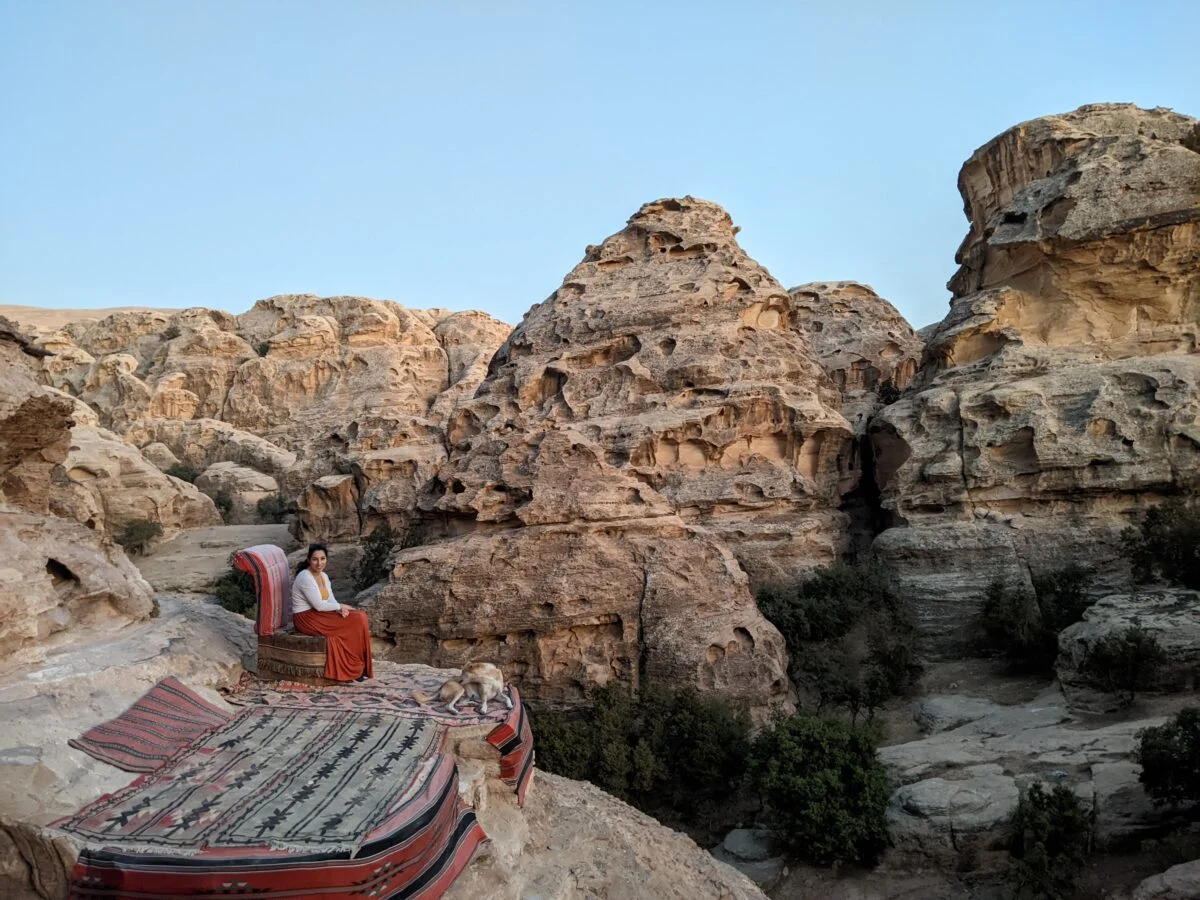
Once we met our guide, we went to Little Petra. Visiting Little Petra is a good introduction to Nabataean architecture and culture. We went just before sunset, and the light that illuminated the site was beautiful. The place was calm and quiet, there were no people.
Small Petra takes about half an hour to visit, and is free. Often, some tourists avoid it because it does not have the magnificence of its sister Petra, but it is essential to have a complete view of the entire archaeological site.
After the visit, we returned to Uum Sayhoun and headed out of the village to our spartan accommodation. The cave was nice and embellished; however, given the hot temperatures, we preferred to sleep outside in what was a veranda (the cave was part of a private property that had a veranda with a canopy and was entirely fenced).
The next day we headed to Petra, one of the seven wonders of the modern world.
Walking the Siq, the narrow canyon that leads to the Treasury, is a surreal experience. Sunlight plays with the pink and red hues of the stone, revealing the grandeur of the ancient Nabataean capital. But Petra does not end at the Treasury: the Monastery, the Street of the Facades and the Royal Tombs are equally extraordinary.
The visit to the Petra site took the whole day and we stayed until the Petra by Night show.
After dining and overnighting at Uum Sayhoun, we headed to Wadi Rum the next morning.
Wadi Rum: Adventure in the Red Desert
From the echoes of the ruins of Petra, we pass to the silence of the infinite desert of Wadi Rum. This desert has red dunes and imposing rock formations, including the famous “Seven Pillars of Wisdom” from Lawrence D’Arabia’s book.
Wadi Rum calls for both adventure, doing a jeep safari or sleeping in a Bedouin camp, for example, and contemplation. In the silence of the desert and under a starry sky, it is inevitable to think, reflect, and admire.
Wadi Rum offers different accommodations according to your taste and budget. Most have at least one main meal, and many offer a package that includes the desert tour.
Visiting the desert until sunset, dining with the Bedouins around the fire and under a starry sky is truly an unforgettable experience.
On the way back, we briefly stopped to see “Trains in the Desert”, wrecks of the Hejaz station. These trains tell the story of the early 1900s when the Arabs, with the help of T.E. Lawrence, fought against the Turkish-Ottoman Empire that dominated the territory. The Arabs, destroying the tracks and interrupting the passage of trains, devastated the connections and communications of the Turks, winning and ending the Arab Revolt of 1916.
I have nicknamed them “The Ghost Trains”, because seeing these locomotives in the middle of the desert is somewhat surreal.
The Dead Sea: The Relaxing Gift of Nature
The Dead Sea is one of those places worth visiting, not so much for its beauty but for its peculiarity. We relaxed in the Dead Sea twice: the day before going to Wadi Mujib, and then returning from Wadi Rum. We stayed in two different places and the hotel’s offer is quite extensive.
The Dead Sea is the lowest point on Earth. The water is dense with minerals and allows you to float effortlessly. It is recommended to stay in the water for no more than 10-15 minutes. The high percentage of salt can cause irritation to the skin, but especially to the eyes (if wet).
Out of curiosity, I licked the skin on my arm with the tip of my tongue. I’ve never tasted anything more bitter in my entire life, and it took a while for that bitterness to go away. The water leaves the skin almost oily, and the beneficial properties of a swim in this sea are universally recognised.
The mineral-rich black mud offers a natural treatment for the skin. A visit to the Dead Sea is a wellness break surrounded by a calm and relaxing landscape.
My conclusions
Jordan is a country I highly recommend. It can attract both the interest of those who love history and culture, and those who love adventure and nature.
For those who want to dedicate themselves to relaxation, beaches and sea sports, I recommend Aqaba, the lively coastal city overlooking the Red Sea, and a favourite destination for diving and snorkelling. Unfortunately, due to a lack of time, it was not possible to visit it, but I promised myself to go there also because in this itinerary, I could not include the visit of the castles in the desert. For those who want to go to Jordan and also include these places, I suggest thinking of a 15-day itinerary because it allows you to visit better and with more calm and relaxation.
As for the cuisine, the dishes are not very elaborate but very tasty.
Mansaf is the national dish based on lamb, rice and fermented yoghurt, while Maglouba is a tasty stew, crunchy Falafels accompanied by Hummus are taste experiences not to be missed. And then the desserts: Knafeh, with its crunchiness, sweetly concludes every meal.
Around the markets, you will find kiosks selling freshly squeezed fruit juices, the most famous being pomegranate. The best we tasted was in Jerash.
Regarding the locals, I found the people quite friendly and hospitable. In this regard, at the end of the trip, our driver invited us to his house for lunch and to let us meet his family, who were very kind. The Mansaf prepared by his wife, in addition to being divine, fully embodied local hospitality.
It is important to remember that, although Jordan is a progressive and modern country and accustomed to tourists, it still remains a country of Islamic culture, so it is right to respect their culture by dressing decently and behaving with respect.
From the millennial history of Petra, to the adventures in Wadi Mujib and Wadi Rum, from the authentic flavours of cuisine to the regenerating waters of the Dead Sea, Jordan is a journey that leaves a deep mark. An unforgettable experience to be lived at least once in a lifetime, among the wonders of a country that embraces its past while looking to the future.
Leave a Reply