
Visiting the Emerald Island by Car
Many of us, at least once, have been captivated by the stories or scenary of Ireland. That land of legends, Celtic mysticism, and breathtaking landscapes has always called to us . It wasn’t my first time on Irish soil, but it was certainly the first time I explored it behind the wheel of a small car, driving coast to coast with occasional detours inland.
We left on an evening flight, and thanks to the long summer light, we landed with the sun still on the horizon, catching glimpses of Irish cliffs and beaches from above — a preview of the beauty awaiting us. Upon landing in Dublin, the first thing we did was immerse ourselves in Irish culture. What better way than heading straight to a pub for a pint of Guinness and some live traditional music? Our stay in Dublin was brief—just one nigh to rest— as both our arrival and departure were scheduled from the capital. We planned to explore it properly at the end of the trip. Our week-long itinerary focused on visiting some of the Ireland’s main cities: Dublin, Galway, Cork and Kilkenny. From these, we included must-see sites such as the Cliffs of Moher, and the Ring of Kerry. From Dublin, we drove west towards Galway, then down to the Cliffs of Moher, continued along the Ring of Kerry, and finally headed east again toward Cork, Kilkenny, and back to Dublin.
But to visit Ireland only for its cities and the Cliffs of Moher would be a serious mistake. What makes the country truly magical is its heritage—monasteries, castles and archaeological sites—and its folk music which tells the stories of independence, customs and local traditions.
Galway —The City of Tribes
Galway gives its name to the entire county. Its nickname, “City of Tribes” refers to the fourteen powerful merchant families who made the city prosper. Galway stands out for its youthful, vibrant atmosphere, famous for its musical and cultural festivals, and for its deep traditional identity that lives on in the pubs where authentic Irish music is still performed. It’s a compact city that can easily be explored on foot The Latin Quarter is unmissable, full of pubs, restaurants, and craft shops. Galway is also the birthplace of the traditional Claddagh ring, symbolising love, loyalty, and friendship. The famous Lynch’s Castle is nearby—more a fortified house than a castle, so keep your expectations modest. From there, you can walk to the 16th-century Spanish Arch and continue along The Long Walk. For a quiter experience, stroll through Salthill, the seaside residential district. We felt Galway’s authenticity most strongly in the West End, full of independent shops, clubs and pubs. We stayed at The Crane, where we enjoyed a wonderfully engaging live performance of traditional Irish folk music. We truly loved Galway.
Kilkenny —The Marble City
On our the way back to Dublin, we stopped in Kilkenny—for one particular reason: the red one. It was here, in this charming town, that Red Irish Cream Ale, produced by Guinness was born. The nickname “Marble City” comes from its medieval buildings constructed with grey limestone speckled with fossils—not real marble, but beautiful nonetheless. Beyond its delicious full-bodied beer, Kilkenny is known for its imposing castle, Gothic churches, and as the capital of hurling, an ancient Celtic field sport. Historically, it also served as Ireland’s capital until the Cromwellian invasion. Today, Kilkenny is tidy and lively, filled with shops, galleries, and cafés, while its pubs preserve the city’s heritage and identity. It’s a place well worth visiting— and worth staying in for more than just a few hours.
Cork
After Kilkenny, we headed towards Cork, the Republic of Ireland’s second-largest city. My first impression was of a city on a human scale—and I was fascinated by its riverside setting. The city centre sits on an island between two branches of the River Lee. The medieval Old Town is lively, centred around three main streets: St Patrick’s Street, Oliver Plunkett Street, and Paul Street, lined with shops, boutiques, pubs, restaurants, and cafés. Cork has much to offer. After walking through the colourful Shandon District and the elegant Victorian Quarter— with the neoclassical St. Patrick’s Cathedral— visit the English Market, a true symbol of local gastronomy. Housed in a beautiful 18th-century Victorian building, the market delights all the senses with the freshness and quality of its produce. Not far away stands the Cathedral of Saint Fin Barre, a neo-Gothic gem with a French-inspired façade and richly decorated interior of carvings, mosaics, frescoes, and stained glass. Also worth a visit is Blackrock Castle & Observatory, once a defensive fortress on the riverbank, now home to a modern telescope and centre for scientific research —a place where past and future meet.
Other notable stops include Elizabeth Fort, University College, and Cork City Gaol, a former prison resembling a neo-Gothic castle. Art lovers will enjoy the Crawford Art Gallery, and whiskey fans shouldn’t miss the Jameson Distillery. Cork offers plenty— a perfect alternative to the capital.
Dublin
Founded by Vikings on the River Liffey, Dublin is a cosmopolitan, lively, and modern city— yet far less frenetic than London or Paris. It’s a cultural an artistic hub that gave birth to literary giants such as James Joyce, Oscar Wilde, and Samuel Beckett. Ireland’s oldest university, Trinity College, houses one of the world’s most beautiful libraries—the Old Library, home to the Book of Kells, a stunningly illuminated medieval manuscript and one of Ireland’s most treasured artefacts. Other must-sees include Dublin Castle, St. Patrick’s Cathedral, Christ Church Cathedral, and the statue of Molly Malone. Stroll through St. Stephen’s Green or along Grafton Street, full of shops, restaurants, cafés, and lively street performers. For cultural insight, visit EPIC the Irish Emigration Museum or MoLI, the Museum of Literature Ireland. Beer lovers, can’t miss the Guinness Storehouse—then end the day in the pubs of Temple Bar, between a pint and a traditional song.
Among Legendary Castles, Silent Monasteries, and Ancestral Sites.
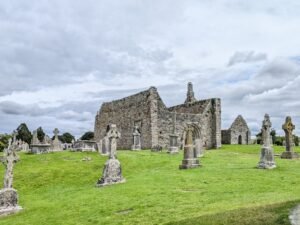
Halfway to Galway, we stopped Clonmacnoise Monastery, one of Ireland’s oldest. Founded by Saint Ciarán in the 6th century, on the banks of the River Shannon, it sits amid lush green fields, and exudes a timeless peace. The small museum houses Celtic crosses and tombstones, while the surrounding grounds feature the monastery’s remains and an ancient cemetery filled with striking stone crosses.
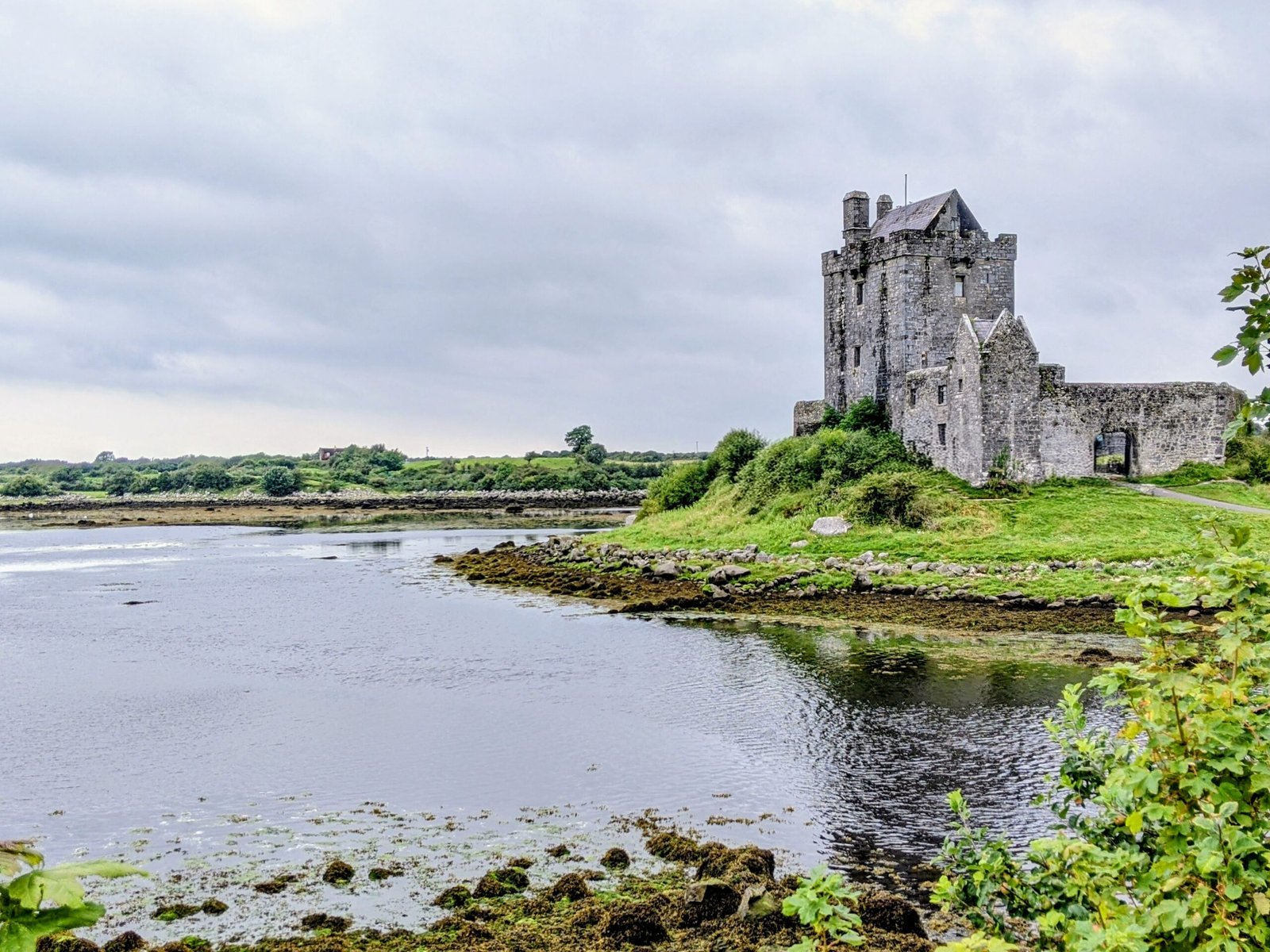
Ireland, of course, is famed for its castles—some in ruins, like as Ballycarbery Castle, and others not always open to the public, like the beautiful Dunguaire Castle, on Galway Bay. On our return to Dublin, we stopped at two must-see sites: the Rock of Cashel, perched dramatically on a limestone hill and surrounded by medieval buildings, and Blarney Castle, near Cork— famous for the Blarney Stone, said to grant the gift of eloquence to those who kiss it.
We also took detours inland to visit Ireland’s “ancestral” archaeological sites: the Poulnabrone Dolmen, the country’s oldest megalithic monument, in the Burren National Park and the ancient ring forts of Cahergal and Leacanabuaile, whose remote locations add to their mysterious aura.
The Ancient and Mystical Nature of Ireland
Ireland’s landscapes don’t just make you dream— they leave you speechless. Travelling by car is the best way to take them in slowly and fully.
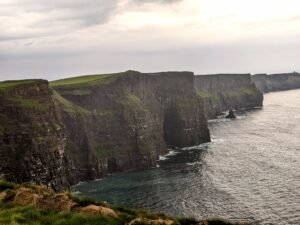
From Galway, we drove south along the coast to Doolin, a charming village that serves as a base for exploringthe the Cliffs of Moher. The cliff’s geopark is vast, and the visitor centre provides a great viewing route . When we visited, the weather turned wild—strong winds and heavy rain forced us to turn back— but not before we caught a glimpse of the cliffs meeting the fierce Atlantic below.
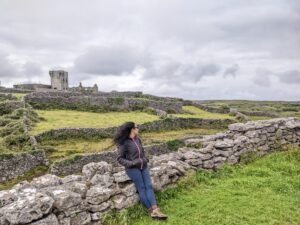
Another place that deeply impressed us was Inisheer (Inis Oirr), one of the three Aran Islands. Known for their rugged beauty and as guardians of Gaelic culture, language, and traditions, these islands are dotted with castle ruins, old churches, shipwrecks, and lighthouses amid green fields and dry stone walls.. Visiting at least one of them offers a truly authentic Irish experience.
The Ring of Kerry— Between Villages and Coastlines
The Ring of Kerry is a spectacular coastal drive of breathtaking scenary— a MUST for anyone exploring southern Ireland. We stayed in Killarney, the gateway to national park of the same name. Apart from its beautiful cathedral, the town itself has no other attractions,it’s small but charming, with good restaurants, pubs, and shops. Although it is possible to drive the entire Ring of Kerry in a day, I’d recomend taking it slow— enjoy the ocean views, stroll along the beaches, and stop in the picturesque fishing villages along the way.
Irish Evenings
Our evenings in Ireland always ended the same way— in a pub. It may sound repetitive, but we loved it. Wherever we went, we ate well: plenty of fresh fish like mussels, salmon and chowder, as well as delicious meat dishes. Beer, cider, and Irish coffee were constant companions, and nights always ended singing with locals traditional songs.
The People
And what can i say about the people? Warm, friendly, and welcoming everywhere we went In pubs, there was always someone ready for a chat, and in rural B&Bs, the hosts embodied Irish hospitality— kind, attentive, and genuinely open-hearted. The warmth of the Irish, I’d say, is inversely proportional to the temperature.
Conclusions
Ireland has confirmed itself as a country not only of extraordinary natural beauty but also one where the past echoes vividly in the present— through its culture, customs, and traditions. My advise: visit Ireland slowly, take your time, and connect with the locals. Do that, and you won’t just leave as a visitor— you’ll leave as a friend.