Category: travels

  • Memories of a travel in Ireland: Visiting the Emerald Island

    Memories of a travel in Ireland: Visiting the Emerald Island


    Visiting the Emerald Island by Car

    Many of us, at least once, have been captivated by the stories or scenary of Ireland. That land of legends, Celtic mysticism, and breathtaking landscapes has always called to us .                              It wasn’t my first time on Irish soil, but it was certainly the first time I explored it behind the wheel of a small car, driving coast to coast with occasional detours inland.

    We left on an evening flight, and thanks to the long  summer light, we landed with the sun still on the horizon, catching glimpses of Irish cliffs and beaches from above — a preview of the beauty awaiting us. Upon landing in Dublin, the first thing we did was immerse ourselves in Irish culture. What better way than heading straight to a pub for a pint of Guinness and some live traditional music?                                                                                Our stay in Dublin was brief—just one nigh to rest— as both our arrival and departure were scheduled from the capital. We planned to explore it properly at the end of the trip.                           Our week-long itinerary focused on visiting some of the Ireland’s main cities: Dublin, Galway, Cork and Kilkenny.                        From these, we included must-see sites such as the Cliffs of Moher, and the Ring of Kerry. From Dublin, we drove west towards Galway, then down to the Cliffs of Moher, continued along the Ring of Kerry, and finally headed  east again toward Cork, Kilkenny, and back to Dublin.


    But to visit Ireland only for its cities and the Cliffs of Moher would be a serious mistake. What makes the country truly magical is its heritage—monasteries, castles and archaeological sites—and its folk music which tells the stories of independence, customs and local traditions.


    Galway —The City of Tribes

    Galway gives its name to the entire county. Its nickname, “City of Tribes” refers to the fourteen powerful merchant families who made the city prosper. Galway stands out for its youthful, vibrant atmosphere, famous for its musical and cultural festivals, and for its deep traditional identity that lives on in the pubs where authentic Irish music is still performed.                                              It’s a compact city that can easily be explored on foot                        The Latin Quarter is unmissable, full of pubs, restaurants, and craft shops. Galway is also the birthplace of the traditional Claddagh ring, symbolising love, loyalty, and friendship. The famous Lynch’s Castle is nearby—more a fortified house than a castle, so keep your expectations modest. From there, you can walk to the 16th-century Spanish Arch and continue along The Long Walk.                                                                                                For a quiter experience, stroll through Salthill, the seaside residential district. We felt Galway’s authenticity most strongly in the West End, full of independent shops, clubs and pubs. We stayed at The Crane, where we enjoyed a wonderfully engaging live performance of traditional Irish folk music.                            We truly loved Galway.

    Kilkenny —The Marble City

    On our the way back to Dublin, we stopped in Kilkenny—for one particular reason: the red one.                                                               It was here, in this charming town, that Red Irish Cream Ale, produced by Guinness was born.                                                      The nickname “Marble City” comes from its medieval buildings constructed with grey limestone speckled with fossils—not real marble, but beautiful nonetheless.                                                Beyond its delicious full-bodied beer, Kilkenny is known for its imposing castle, Gothic churches, and as the capital of hurling, an ancient Celtic field sport. Historically, it also served as Ireland’s capital until the Cromwellian invasion. Today, Kilkenny is tidy and lively, filled with shops, galleries, and cafés, while its pubs preserve the city’s heritage and identity. It’s a place well worth visiting— and worth staying in for more than just a few hours.

    Cork

    After Kilkenny, we headed towards Cork, the Republic of Ireland’s second-largest city. My first impression was of a city on a human scale—and I was fascinated by its riverside setting.      The city centre sits on an island between two branches of the River Lee. The medieval Old Town is lively, centred around three main streets: St Patrick’s Street, Oliver Plunkett Street, and Paul Street, lined with shops, boutiques, pubs, restaurants, and cafés.    Cork has much to offer. After walking through the colourful Shandon District and the elegant Victorian Quarter— with the neoclassical St. Patrick’s Cathedral— visit the English Market, a true symbol of local gastronomy. Housed in a beautiful 18th-century Victorian building, the market delights all the senses with the freshness and quality of its produce.  Not far away stands the  Cathedral of Saint Fin Barre, a neo-Gothic gem with a French-inspired façade and richly decorated interior of carvings, mosaics, frescoes, and stained glass. Also worth a visit is Blackrock Castle & Observatory, once a defensive fortress on the riverbank, now home to a modern telescope and centre for scientific research —a place where past and future meet. 

    Other notable stops include Elizabeth Fort, University College, and Cork City Gaol, a former prison resembling a neo-Gothic castle. Art lovers will enjoy the Crawford Art Gallery, and whiskey fans shouldn’t miss the Jameson Distillery.                                          Cork offers plenty— a perfect alternative to the capital.

    Dublin

    Founded by Vikings on the River Liffey, Dublin is a cosmopolitan, lively, and modern city— yet far less frenetic than London or Paris. It’s a cultural an artistic hub that gave birth to literary giants such as James Joyce, Oscar Wilde, and Samuel Beckett.         Ireland’s oldest university, Trinity College, houses one of the world’s most beautiful libraries—the Old Library, home to the Book of Kells, a stunningly illuminated medieval manuscript and one of Ireland’s most treasured artefacts.                                   Other must-sees include Dublin Castle, St. Patrick’s Cathedral, Christ Church Cathedral, and the statue of Molly Malone. Stroll through St. Stephen’s Green or along Grafton Street, full of shops, restaurants, cafés, and lively street performers.                              For cultural insight, visit  EPIC the Irish Emigration Museum or MoLI, the Museum of Literature Ireland. Beer lovers, can’t miss the Guinness Storehouse—then end the day in the pubs of Temple Bar, between a pint and a traditional song.


    Among Legendary Castles, Silent Monasteries, and Ancestral Sites.

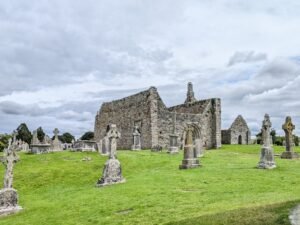
    Halfway to Galway, we stopped Clonmacnoise Monastery, one of Ireland’s oldest. Founded by Saint Ciarán in the 6th century, on the banks of the River Shannon, it sits amid lush green fields, and exudes a timeless peace. The small museum houses Celtic crosses and tombstones, while the surrounding grounds feature the monastery’s remains and an ancient cemetery filled with striking stone crosses.

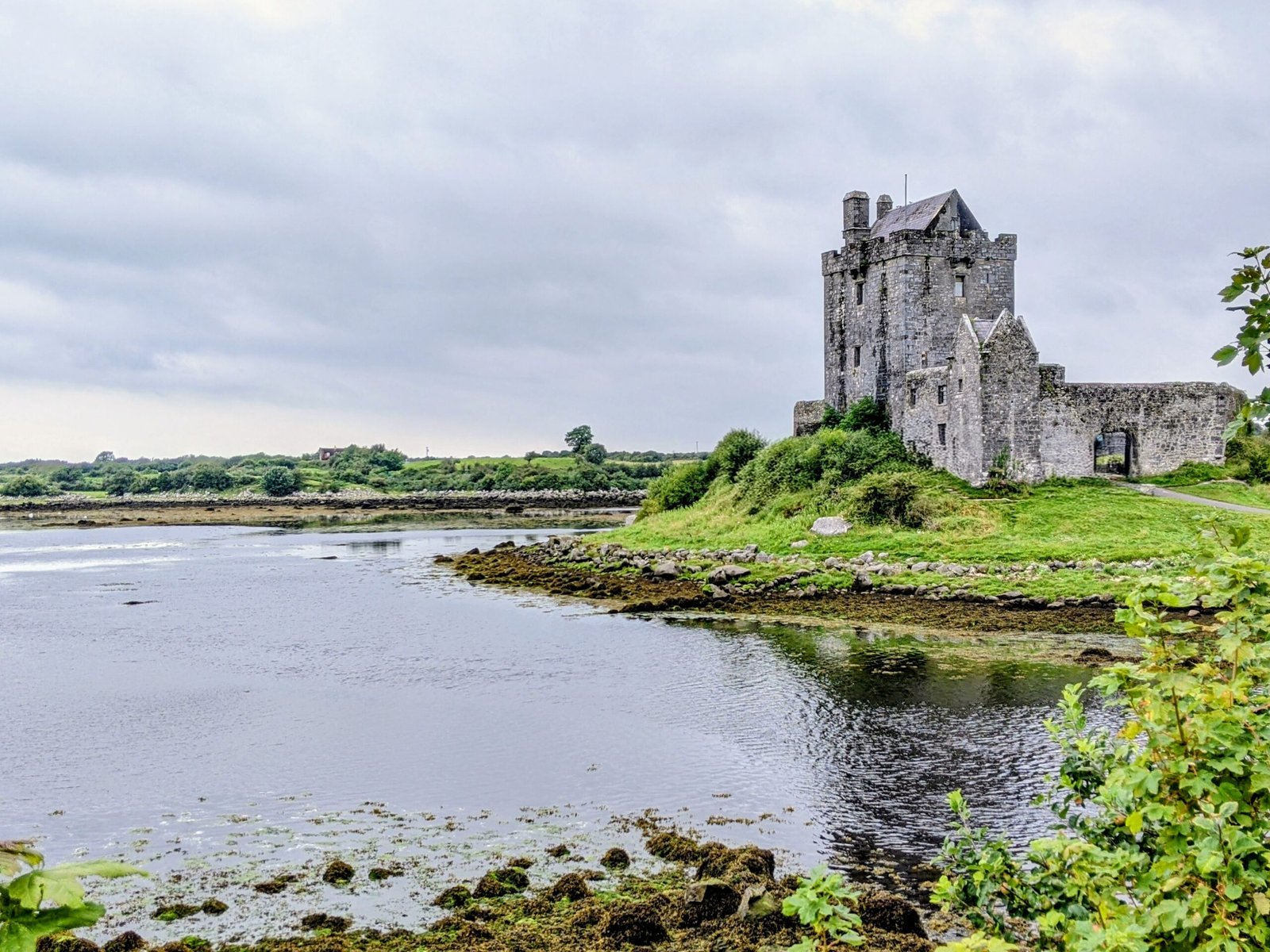
    Ireland, of course, is famed for its castles—some in ruins, like as Ballycarbery Castle, and others not always open to the public, like the beautiful Dunguaire Castle, on Galway Bay. On our return to Dublin, we stopped at two must-see sites: the Rock of Cashel, perched dramatically on a limestone hill and surrounded by medieval buildings, and Blarney Castle, near Cork— famous for the Blarney Stone, said to grant the gift of eloquence to those who kiss it. 

     We also took detours inland to visit Ireland’s “ancestral” archaeological sites: the Poulnabrone Dolmen, the country’s oldest megalithic monument, in the Burren National Park and the ancient ring forts of Cahergal and Leacanabuaile, whose remote locations add to their mysterious aura.


    The Ancient and Mystical Nature of Ireland 

    Ireland’s landscapes don’t just make you dream— they leave you speechless. Travelling by car is the best way to take them in slowly and fully.

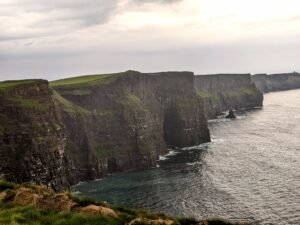
    From Galway, we drove south along the coast to Doolin, a charming village that serves as a base for exploringthe the Cliffs of Moher. The cliff’s geopark  is vast, and the visitor centre provides a great viewing route . When we visited, the weather turned wild—strong winds and heavy rain forced us to turn back— but not before we caught a glimpse of the cliffs meeting the fierce Atlantic below. 

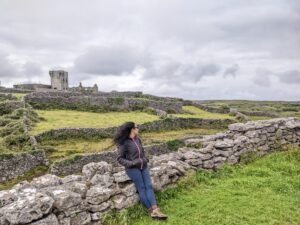
     Another place that deeply impressed us was Inisheer (Inis Oirr), one of the three Aran Islands. Known for their rugged beauty and as guardians of Gaelic culture, language, and traditions, these islands are dotted  with castle ruins, old churches, shipwrecks, and lighthouses amid green fields and dry stone walls.. Visiting at least one of them offers a truly authentic Irish experience.

    The Ring of Kerry— Between Villages and Coastlines

    The Ring of Kerry is a spectacular coastal drive of breathtaking scenary— a MUST for anyone exploring southern Ireland.                We stayed in Killarney, the gateway to national park of the same name. Apart from its beautiful cathedral, the town itself has no other attractions,it’s small but charming, with good restaurants, pubs, and shops.                                                                            Although it is possible to drive the entire  Ring of Kerry in a day, I’d recomend taking it slow— enjoy the ocean views, stroll along the beaches, and stop in the picturesque fishing villages along the way.

    Irish Evenings

    Our evenings in Ireland always ended the same way— in a pub. It may sound repetitive, but we loved it. Wherever we went, we ate well: plenty of fresh fish like mussels, salmon and chowder, as well as delicious meat dishes. Beer, cider, and Irish coffee were constant companions, and nights always ended singing with locals traditional songs.

    The People

    And what can i say about the people? Warm, friendly, and welcoming  everywhere we went In pubs, there was always someone ready for a chat, and in rural B&Bs, the hosts embodied Irish hospitality— kind, attentive, and genuinely open-hearted. The warmth of the Irish, I’d say, is inversely proportional to the temperature.

    Conclusions

    Ireland has confirmed itself as a country not only of extraordinary natural beauty but also one where the past echoes vividly in the present— through its culture, customs, and traditions.                      My advise: visit Ireland slowly, take your time, and connect with the locals. Do that, and you won’t just leave as a visitor— you’ll leave as a friend.


  • Petra, the Silent Wonder: between Myth, Sand and Glory

    Petra, the Silent Wonder: between Myth, Sand and Glory

    Petra, the Silent Wonder: between Myth, Sand and Glory

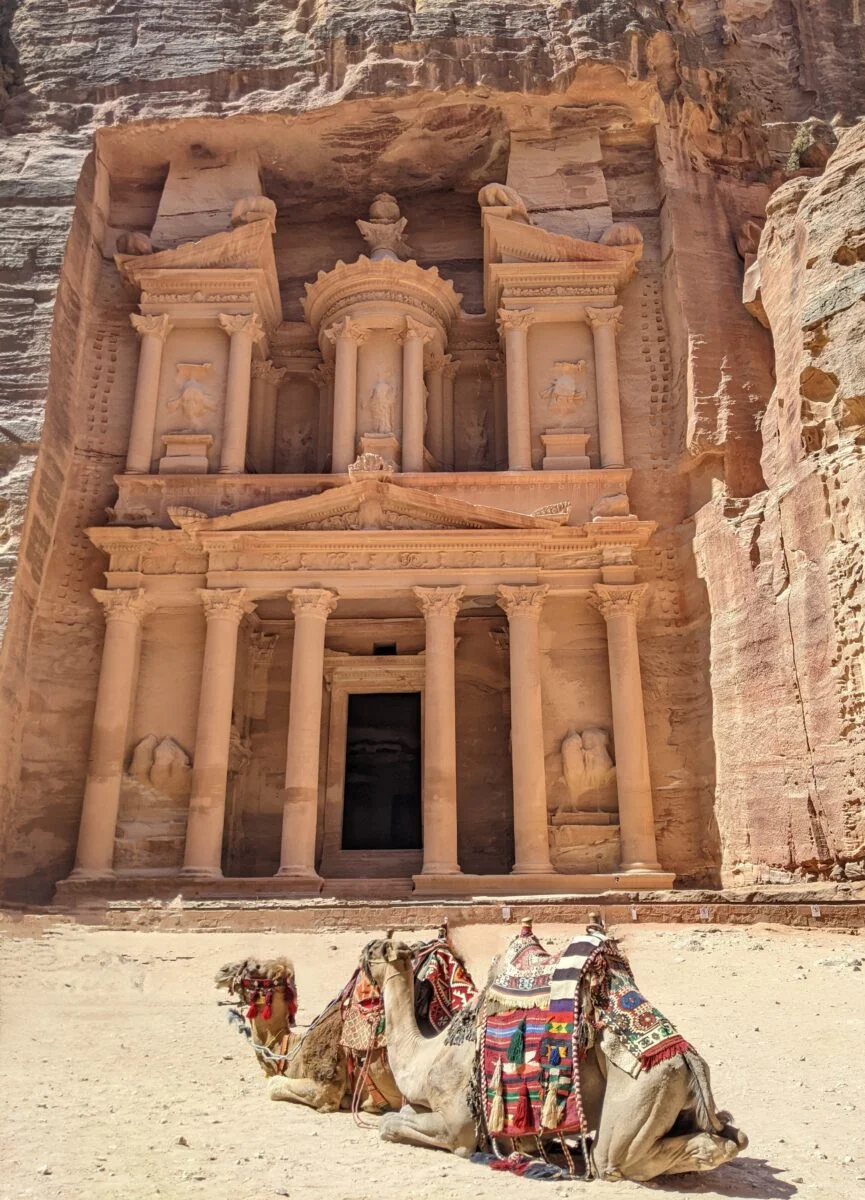
    Visiting Petra was a dream come true. A dream that began when I was very young and growing up with Indiana Jones. Resisting to its charm was impossible. The legendary city of Petra is in the Jordanian desert, nestled among sunlit rocks that are tinged with red, orange, and gold. It is a magical place. Once there, its magnetic beauty captures you: it is unique, and describing its splendour, shrouded in the mystery of time, is difficult. To get there, you must first pass through the Siq, a narrow canyon that leads to the hidden city. Passing through the Siq is an unique experience itself: every step increases the euphoria and you can catch the traces left by its inhabitants. On the walls, you begin to glimpse steps and silhouettes engraved in the rock, making the imagination grow. The Siq slowly tells the story of its life. Caravans, merchants and travellers had to pass through this canyon to reach the ancient city of Petra. An opening between the rocks gives a glimpse of what looks like a mirage. At every step, the gorge opens and in all its beauty shows its Treasury, the Khazneh. It takes your breath away for its splendour and goes far beyond amazement, you are enchanted by such magnificence. The facade of the Treasury is there, eternal, shining with its light and testifying the golden age of its people, the Nabataeans, who made the desert their cradle of civilisation. It is perfect in every detail. But Petra is not only its Treasury but an entire intriguing city, made up of streets, houses, temples (the Monastery above the city is a must), tombs and amphitheatres, each with its own identity engraved in the rock. Walking through its dusty streets is like flipping through the pages of an ancient book, where every detail tells of revered gods, broken loves and dreams of a glory that was, and never faded. We stayed in the hidden city all day (but adding at least another half day would help to see everything more calmly), and we finished our visit in the late afternoon. It was wonderful to see the sunset from the Monastery, from where you could contemplate the beauty of the mountain valley. With twilight, Petra transforms again, the last rays of sun colour the whole hidden city in orange. In the evening, the city is wrapped in a reverential silence. Time stops again. The moon and stars illuminate the sky of Petra, and in that mystical silence you can almost feel the spirit of the ancient Nabataeans, alive and immortal among the rocks of their beloved city. Petra is first dreamed and then visited, and once the threshold of this wonder is crossed, a part of your soul remains there forever.

  • Jordan: A Journey Through History, Culture and Millennial Wonders

    Jordan: A Journey Through History, Culture and Millennial Wonders

    Jordan: A Journey Through History, Culture and Millennial Wonders

    Jordan has always been on my bucket list. As a child, it was for me the place of one of the Seven Wonders of the World, Petra, but little by little I learnt that this land offered much more.
    Despite being an Islamic country, its historical-archaeological heritage includes a legacy left by Romans, Crusaders, Jews and Christians, while its natural heritage includes the famous Dead Sea, the Red Sea and the Wadi Rum desert.
    Jordan is a set of emotions, a mix of cultures, smells and tastes. A place where there is no shortage of adventure and the landscape always leaves you breathless.
    Having the opportunity to visit Jordan independently (we relied on a private driver) allowed us to visit the places we chose and according to our schedule.
    Each place visited contained a story, even that History that is studied in books.

    Amman and Jordanian Culture

    Jordan has two international airports, one in Aqaba, in the south of the country and perfect for those who want to dedicate themselves to the Red Sea, for example, and one in Amman, the capital, which is located to the north. We landed on the latter.
    Amman is a city that blends modernity and tradition. The streets of the Citadel tell the story of the Roman past, with the Temple of Hercules and the Roman Theatre. In the centre, there are historic cafes where you can breathe the scent of cardamom mixed with Arab coffee, while in the souks, markets, the call of spices and colourful fabrics invites travellers to let themselves be absorbed by the local culture. Amman abounds with traditional restaurants but also modern bistros. I always opt for the former.
    I recommend dedicating at least 2 full days to Amman, especially if you intend to visit some museums. The Archaeological Museum, for example, houses some of the Dead Sea Scrolls.

    Jerash: A tresure left by Romans

    North of Amman, an hour away, is the city of Jerash, nicknamed the Pompeii of the East. Here, we find one of the best-preserved Roman archaeological sites in the world.
    The visit begins from the imposing Arch of Hadrian, which allows you to imagine the grandeur and beauty of the site. From there, you can stroll through cobbled streets, imposing temples, well-preserved theatres and the majestic Oval Forum, surrounded by an elegant colonnade.
    In the city’s ancient main street, the Cardo Massimo, you can still observe the furrows left by Roman-era wagons.
    The Jerash site is kept alive; in fact, the South Theatre is still used for shows and concerts thanks to its surprising acoustics.
    Visiting Jerash takes half a day, and from Amman, there are regularly organised excursions, including from hotels, and back to the capital.

    Madaba: The City of Mosaics

    South of Amman, there is the city of Madaba, famous for the extraordinary mosaic tradition witnessed by the famous “Map of Madaba”, a 6th-century Byzantine mosaic preserved in the Church of St. George. This masterpiece represents the Holy Land with a unique cartographic precision, revealing itself as a precious historical testimony.
    In addition to the Madaba Map, the city is home to numerous other mosaics of equal beauty scattered among churches and archaeological sites. It is worth visiting the Madaba Archaeological Park, where there are remains of ancient Byzantine and Roman churches, as well as the Church of the Apostles, which houses a magnificent mosaic depicting Thalassa, the female personification of the sea, surrounded by fishes and sea creatures, flowers, fruits and angelic faces.
    Madaba too does not take much time, indeed, a couple of hours are more than enough, so once you visit the main sites you can leave for other places.
    On the same day, my itinerary took us to places particularly felt by believers. Unmissable places for those taking a trip to the Holy Land.

    Biblical Jordan: In the Footsteps of Faith

    Jordan also holds places of profound religious significance. There are two sites of most interest. Mount Nebo, the place from which Moses saw the Promised Land, offers a breathtaking view of the Jordan Valley, and Bethany beyond the Jordan, which is recognised as the place of Jesus’ baptism, a site of great importance for pilgrims from all over the world.
    On Mount Nebo, once through the entrance, you can freely walk, visiting the garden and the church. In Bethany beyond the Jordan, it is mandatory to be accompanied and take part in a tour. In fact, when we arrived at the ticket office, we waited about ten minutes for the tour to start. With a shuttle, we headed to the place of interest. We walked along a dusty road, with solitary churches scattered in the barren landscape.
    The main reason that obliges the accompaniment of visitors is that Bethany beyond the Jordan is located on the border line with the West Bank. Beyond the river, you can see the Israeli flag and armed soldiers.
    The Jordan River has changed a lot over the centuries, both for geological reasons and because of heavy human interventions (construction of catchment basins and diversion of the river), reducing its flow and reducing it to a mere river. The site and route are quite neat and clean. There is also a church that you can visit, but nothing extraordinary. For me, the visit to the baptismal site was worth it, especially for its religious significance. The place is quiet and conveys serenity, but the expectations Vs reality may not coincide.
    Once we finished our visit to Bethany across the Jordan, we headed south. Our destination was Wadi Mujib.

    Wadi Mujib: The Grand Canyon of Jordan 

    The Mujib Biosphere Reserve is the lowest nature reserve in the world. It is a spectacular reserve with a unique biodiversity: water that flows all year round, fed by seven tributaries, a difference in altitude that goes from 410 m below sea level to 900 m above sea level. Mountains, valleys and cliffs make it perfect for many species of wild animals as well as hundreds of species of plants.
    In terms of activity, the Wadi Mujib offers trekking, hiking, an adrenaline-pumping zip line and canyoning between sinuous rock walls, which are tinged with colours ranging from grey to orange, contrasting with the blue of the water that leads to refreshing waterfalls.
    The Wadi Mujib, thanks to its geographical characteristics, offers different trails depending on the preference of the landscape, the timing, the activities to be done and the ease of the route. Some of them require the presence of a guide. Some trails in the winter are closed for safety reasons, so my advice is to find out what you want to do and then contact the Visitor Centre.
    We opted for the Siq Trail, which is short, rewarding and easily accessible in total autonomy. With its narrow gorges and natural pools, it offers strong emotions and beautiful views. Despite the challenge of crossing the river and its countercurrent waterfalls, it was still relaxing to immerse yourself in nature.
    I would love to go back there to be able to do the other trails as well. So yes, if you are an adventure lover like me, the Wadi Mujib Biosphere Reserve deserves and is a must.
    Il giorno seguente, con calma, abbiamo lasciato il Wadi Mujib e ci siamo diretti verso il Wadi Musa alla scoperta di Petra.

    Wadi Musa and Petra: The Pink City of the Desert 

    Leaving the adventure behind, we headed towards the Wadi Musa. The distance is 2 hours and 45 minutes, although we took longer. In fact, we got lost due to a lack of signage. Our driver relied on Google Maps, but being close to the Israeli border, there was interference and the signal was interrupted. Fortunately, our driver was Jordanian and had no problem asking for information. However, this is not an insurmountable problem, I know of many travellers who have driven to Jordan on their own, just have a road map or offline maps.
    We had crossed an arid landscape, where there was only one road and a few dry bushes, and we crossed paths with a goat herder and occasionally some other off-roaders.
    Before leaving, I contacted a Bedouin guide with whom we would meet in Uum Sayhoun, the Bedouin village built by the government. Generally, tourists stay in Wadi Musa, but to support the already precarious Bedouin economy, I decided to rely on this guide who would accompany us around and let us stay in a cave near a small ravine.
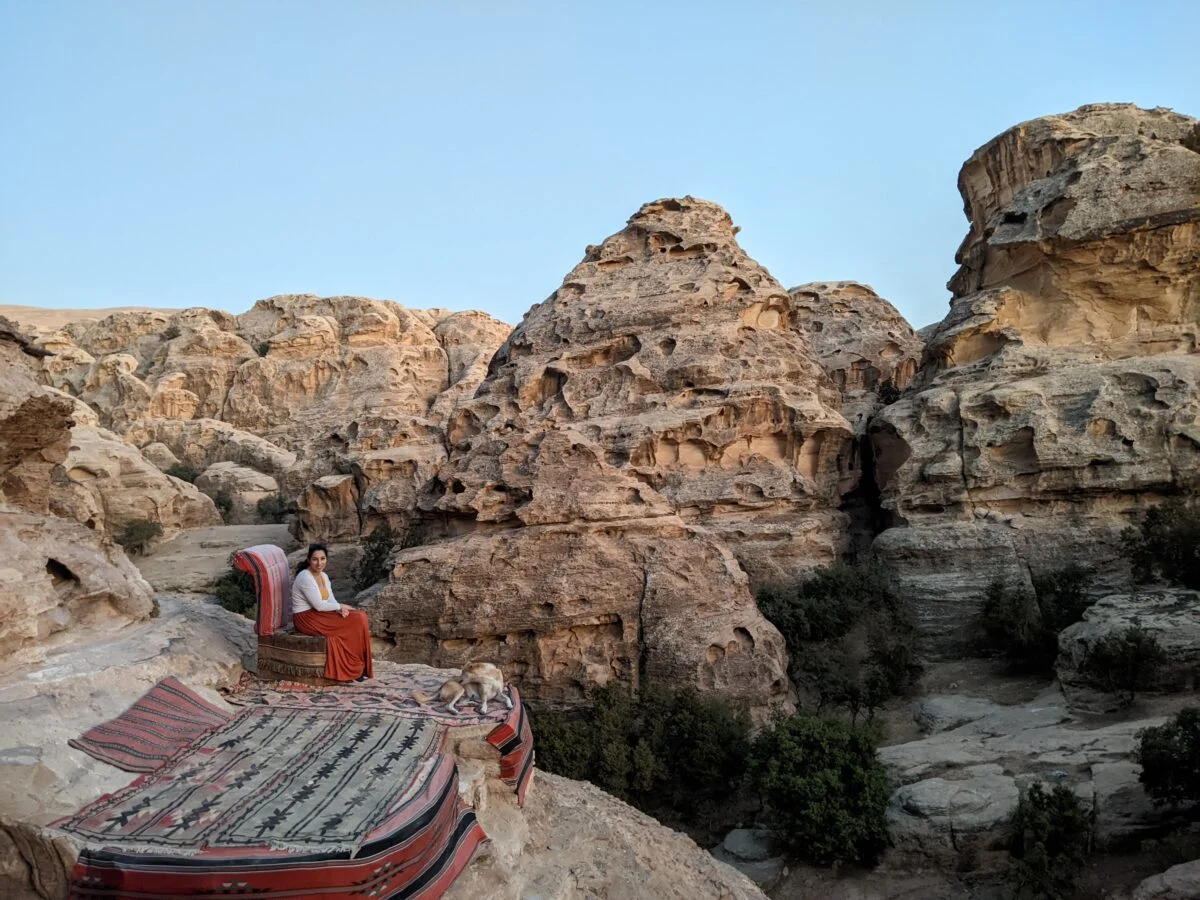
    Once we met our guide, we went to Little Petra. Visiting Little Petra is a good introduction to Nabataean architecture and culture. We went just before sunset, and the light that illuminated the site was beautiful. The place was calm and quiet, there were no people.
    Small Petra takes about half an hour to visit, and is free. Often, some tourists avoid it because it does not have the magnificence of its sister Petra, but it is essential to have a complete view of the entire archaeological site.
    After the visit, we returned to Uum Sayhoun and headed out of the village to our spartan accommodation. The cave was nice and embellished; however, given the hot temperatures, we preferred to sleep outside in what was a veranda (the cave was part of a private property that had a veranda with a canopy and was entirely fenced).
    The next day we headed to Petra, one of the seven wonders of the modern world.
    Walking the Siq, the narrow canyon that leads to the Treasury, is a surreal experience. Sunlight plays with the pink and red hues of the stone, revealing the grandeur of the ancient Nabataean capital. But Petra does not end at the Treasury: the Monastery, the Street of the Facades and the Royal Tombs are equally extraordinary.
    The visit to the Petra site took the whole day and we stayed until the Petra by Night show.
    After dining and overnighting at Uum Sayhoun, we headed to Wadi Rum the next morning.

    Wadi Rum: Adventure in the Red Desert

    From the echoes of the ruins of Petra, we pass to the silence of the infinite desert of Wadi Rum. This desert has red dunes and imposing rock formations, including the famous “Seven Pillars of Wisdom” from Lawrence D’Arabia’s book.
    Wadi Rum calls for both adventure, doing a jeep safari or sleeping in a Bedouin camp, for example, and contemplation. In the silence of the desert and under a starry sky, it is inevitable to think, reflect, and admire.
    Wadi Rum offers different accommodations according to your taste and budget. Most have at least one main meal, and many offer a package that includes the desert tour.
    Visiting the desert until sunset, dining with the Bedouins around the fire and under a starry sky is truly an unforgettable experience.
    On the way back, we briefly stopped to see “Trains in the Desert”, wrecks of the Hejaz station. These trains tell the story of the early 1900s when the Arabs, with the help of T.E. Lawrence, fought against the Turkish-Ottoman Empire that dominated the territory. The Arabs, destroying the tracks and interrupting the passage of trains, devastated the connections and communications of the Turks, winning and ending the Arab Revolt of 1916.
    I have nicknamed them “The Ghost Trains”, because seeing these locomotives in the middle of the desert is somewhat surreal.

    The Dead Sea: The Relaxing Gift of Nature  

    The Dead Sea is one of those places worth visiting, not so much for its beauty but for its peculiarity. We relaxed in the Dead Sea twice: the day before going to Wadi Mujib, and then returning from Wadi Rum. We stayed in two different places and the hotel’s offer is quite extensive.
    The Dead Sea is the lowest point on Earth. The water is dense with minerals and allows you to float effortlessly. It is recommended to stay in the water for no more than 10-15 minutes. The high percentage of salt can cause irritation to the skin, but especially to the eyes (if wet).
    Out of curiosity, I licked the skin on my arm with the tip of my tongue. I’ve never tasted anything more bitter in my entire life, and it took a while for that bitterness to go away. The water leaves the skin almost oily, and the beneficial properties of a swim in this sea are universally recognised.
    The mineral-rich black mud offers a natural treatment for the skin. A visit to the Dead Sea is a wellness break surrounded by a calm and relaxing landscape.

    My conclusions

    Jordan is a country I highly recommend. It can attract both the interest of those who love history and culture, and those who love adventure and nature.
    For those who want to dedicate themselves to relaxation, beaches and sea sports, I recommend Aqaba, the lively coastal city overlooking the Red Sea, and a favourite destination for diving and snorkelling. Unfortunately, due to a lack of time, it was not possible to visit it, but I promised myself to go there also because in this itinerary, I could not include the visit of the castles in the desert. For those who want to go to Jordan and also include these places, I suggest thinking of a 15-day itinerary because it allows you to visit better and with more calm and relaxation.
    As for the cuisine, the dishes are not very elaborate but very tasty.
    Mansaf is the national dish based on lamb, rice and fermented yoghurt, while Maglouba is a tasty stew, crunchy Falafels accompanied by Hummus are taste experiences not to be missed. And then the desserts: Knafeh, with its crunchiness, sweetly concludes every meal.
    Around the markets, you will find kiosks selling freshly squeezed fruit juices, the most famous being pomegranate. The best we tasted was in Jerash.
    Regarding the locals, I found the people quite friendly and hospitable. In this regard, at the end of the trip, our driver invited us to his house for lunch and to let us meet his family, who were very kind. The Mansaf prepared by his wife, in addition to being divine, fully embodied local hospitality.
    It is important to remember that, although Jordan is a progressive and modern country and accustomed to tourists, it still remains a country of Islamic culture, so it is right to respect their culture by dressing decently and behaving with respect.

    From the millennial history of Petra, to the adventures in Wadi Mujib and Wadi Rum, from the authentic flavours of cuisine to the regenerating waters of the Dead Sea, Jordan is a journey that leaves a deep mark. An unforgettable experience to be lived at least once in a lifetime, among the wonders of a country that embraces its past while looking to the future.

  • Journey in Apulia: Among white villages, authentic flavours and natural wonders

    Journey in Apulia: Among white villages, authentic flavours and natural wonders

    Apulia, a Travel in Time and Beauty

    They said that Apulia is a state of mind and actually this is true.
    It is a welcoming land that knows how to thrill and win people’s hearts.
    Its charm is unveiled in the little old towns, in the cities of art, in its unique landscapes, and in its cuisine that smells of tradition. This is a journey that will take you among cobblestone streets called “Chianche”, in Mottola, going through the Trulli of Alberobello, the breathtaking views of Polignano a Mare, up to the World Heritage Site of Sassi of Matera in the near region Basilicata. Let’s get ready to discover an itinerary that mixes culture, relaxation, and unforgettable experiences.

    Mottola: la Spia dello Ionio

    The journey starts in Mottola, nicknamed “The Spy of the Ionian”, for its strategic view on the Gulf of Taranto. Its old town charms with a labyrinth of alleys and cobblestone streets, as also do the churches (the oldest is dated back to the XII Century). Unmissable is the visit to the cave churches, like the crypt of St Nicholas, a jewel of Byzantine art carved in the rock. The woods and the nearby countryside such as the Petruscio Gravina, offer beautiful and bucolic hiking trails, and do not miss tasting the local dishes: focacce and dairy products are a delight.

    Taranto: la città dei due mari

    Taranto is a city with an appeal of its own, it’s nicknamed “The City of the Two Seas” because of its position between the Big Sea and the Little Sea. Taranto has a very ancient history and was founded by Spartans, it has been an important centre of Magna Graecia, as evidenced by artifacts preserved in the National Archaeological Museum of Taranto, but also the archaeological sites located in the city. The old town is a travel in time narrow alleys, historical buildings, and the majestic Cathedral of St Cataldo, the oldest cathedral in Apulia. Not far there is the fascinating Aragonese Castle which overlooks the sea, offering beautiful and moving views. The nearby sandy beaches allow you to relax in crystal clear waters, while the locale cuisine which is based on fresh fish and seafood (like the local variety of mussels) is a gastronomic experience not to be missed.

    Alberobello: il paese dei Trulli

    Continuing the journey, we arrive this time in the Itria Valley where it is impossible to not visit Alberobello, as it’s like a fairytale made of stones. Walking in Rione Monti and Aia Piccola you can breathe a timeless atmosphere. Stop and go inside a Trullo and buy handcrafted souvenirs, perhaps something ceramic hand-painted.

    Locorotondo and Cisternino: Balconies on the Itria Valley

    Locorotondo, with its white houses and flowered balconies, is a lovely place to explore on foot and from here the view of the Itria Valley is stunning, especially during sunset. A few kilometers away, Cisternino welcomes visitors with its authentic soul and the “bracerie”: small places where it is possible to choose fresh meat at the counter and have it cooked to eat it there.

    Ostuni: la città bianca

    The journey will take us to Ostuni which is considered a real gem of the Itria Valley. The bright white of its houses contrasts with the blue sky and the green of the centuries-old olive trees. Wander in its alleys and get to the Cathedral of Santa Maria Assunta, another masterpiece of Gothic art. Ostuni is also the perfect destination for those who want to relax thanks to the close proximity to the beaches of the Adriatic coast.

    Polignano a Mare: Poetry and Sea

    Polignano a Mare is a must-see town for sea lovers with a city that rises on a cliff that gives outstanding views. Dive into the blue sea from the beach of Lama Monachile, which is nestled among the high cliffs, and walk in the old town, through its small roads and poetic verses written on walls. Do not forget to stop to enjoy an authentic artisan ice cream or a panino with octopus, which is a local delicacy.

    Monopoli: Mediterranean Charm

    At a short distance, the city of Monopoli welcomes you with its old harbour and its defensive walls on the sea. Here the Baroque churches, Carlo V Castle, and the little cobblestone alleys offer postcard views. The city is perfect for a relaxing walk, ideally with a stop in a local restaurant to taste fresh fish.

    Matera: i Sassi e la magia del tempo

    The journey ends in Matera, the capital city of the region Basilicata. Geographically, it is on the border with Apulia and for this reason, often is included in the same itinerary. Matera is one of the most fascinating places in Italy because of the Sassi, which are the old houses carved in caves and tell an ancient story. It is essential to visit the cave churches and the Palombaro Lungo, an extraordinary underground cistern. Matera also offers cultural experiences such as exhibitions, festivals, and the cinematic charm that made it famous around the world.

    Experiences not to be missed

    • Tasting: try the Itria Valley’s wines and local products such as extra-virgin olive oil, friselle and taralli.
    • Trekking: walk along the trails of Parco della Murgia or Terra delle Gravine.
    • Archaeology and History: do not miss the cave settlements with cave churches embellished with frescoes, the old towns, and the small local museums.
    • Art and traditions: join the local fairs and learn about handicrafts, like the work of pottery, ironwork, or handmade pasta.

    This itinerary will guide you through places that tell stories, experience scents and flavours that you will never forget. Apulia is an invitation to slow down, to wonder and to be enchanted by a generous and authentic South Italy. The above itinerary lasts about a week and focuses on Itria Valley and the surrounding areas. Due to itinerary time constraints, I left out the Gargano and Salento area. I will save them for the next trip. For any enquires or info, please do not hesitate to get in touch. Would you like to visit Apulia with travel buddies? Here is the link for the next group trip. “https://backandforth.travel/viaggi/” target=”_self”>https://backandforth.travel/viaggi/

  • Aurora Borealis: The hypnotic dance in the sky

    Aurora Borealis: The hypnotic dance in the sky

    The magic of Aurora Borealis: the celestial dance of the nature

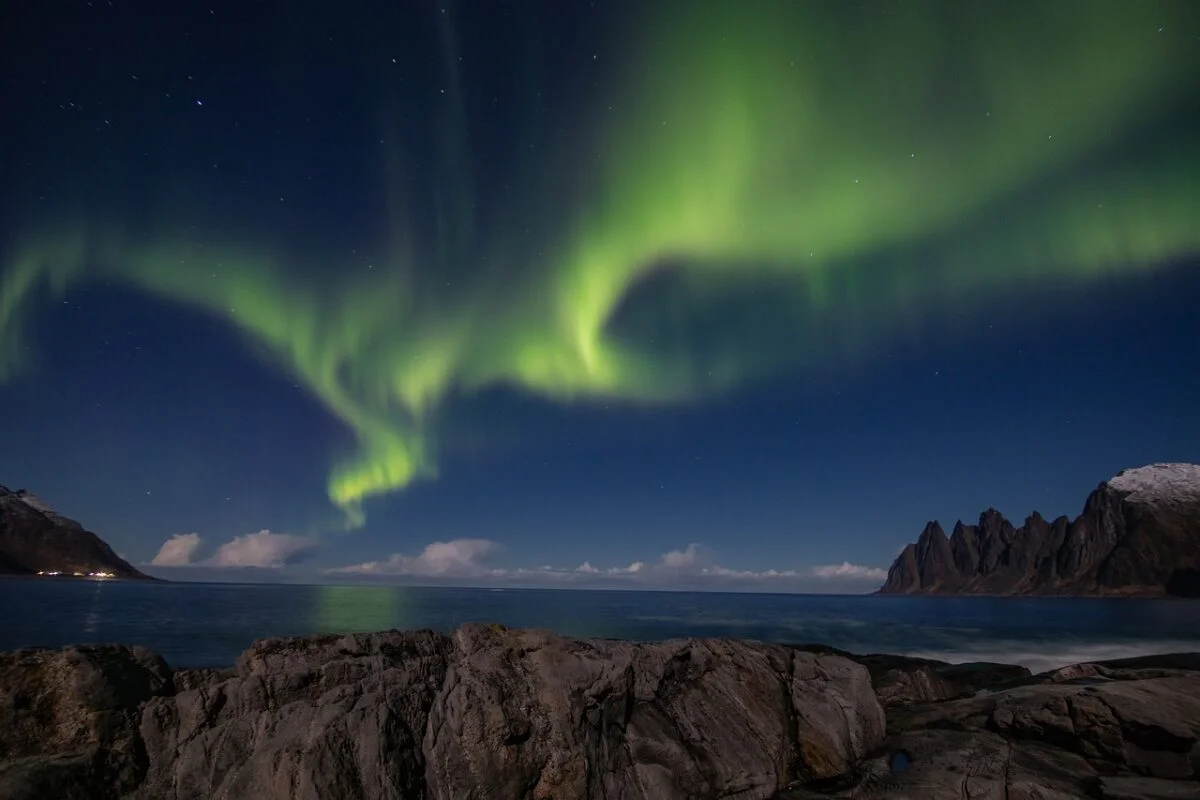
    Few things in the world can compete with the magic of the Aurora Borealis, a natural show that seemed to just come out of a dream. This fascinating glowing prodigy is also known as the”Northern Lights”, it is a phenomenon that links science and imagination, lighting up the night skies with vibrant colours and transforming the ordinary into extraordinary.
    Ancestors called it with different names, like “Lights of the North”, but was Galileo Galilei who coined the name “Aurora Borealis”, joining the name of the Roman goddess of the sunrise, Aurora, to the Greek name of the north wind god, Borea.

    What is an Aurora Borealis?

    An Aurora is the result of a reaction between particles coming from the Sun and the Earth’s magnetic field. When the solar wind – a constant streaming of particles ejected from the Sun’s corona- reaches Earth, some of those particles are caught by the Earth’s magnetic field and are pushed towards the magnetic poles. Here, they interact with the atoms and molecules of our atmosphere such as oxygen, and nitrogen. These interactions free energy in the form of light, creating the peculiar dancing glares in the skies.

    The colour of the Aurora (or Northern Lights), is determined by the gases involved: oxygen produces shades of green and red, while nitrogen gives the blue and purple. The intensity and variety of colours also depends from the density of the atmosphere and the energy of the solar particles.

    A phenomenon that inspires myths and legends

    Northern Lights is not only a scientific event, but it is also a source of folkloristic and spiritual inspiration. Native people, since the dawn of the time, gave spiritual and mystical meanings to those dancing lights. Sami people, natives of Lapland, believe that the Northern Lights are the reflection of the spirits who dance in the sky. Other myths describe it as a celestial runway crossed by the souls, or as divine messages sent to men by the Norse deities, while for others is the tail of the magic arctic fox.
    Also in literature and art, the Aurora Boreale has been an inspiration and symbol of beauty and mystery. Writers and poets have described its shades as metaphors of passion and transformation, while photographs and painters constantly try to capture the ephemeral magic of this spectacular celestial display.

    An intimate meeting with the sky

    Admiring the Northern Lights is an experience that goes beyond the simple observation. It is an intimate meeting with the sky, a moment that recalls the infinity of the universe and our place in its inner. Imagine finding yourself on a freezing night, surrounded by the darkness of the night, immersed in nature. Above you, suddenly the sky erupts with green and purple waves of light. In that moment, time seems to stop and all that matters is the bond between you and the universe.

    Aurora as a promise of enchant

    In the end, the Aurora Borealis is not only a natural phenomenon but also a promise of enchant. This is proof that, even in the most cold and dark nights, there are moments of pure magic, ready to remind us that our world is full of beauty and mystery.
    If you haven’t ever seen this spectacle, let it become one of the most ardent wishes. The sky is ready to tell you a story: a story made of light, colours and dreams that dance in the infinity.

    When and where to see it

    L’Aurora Boreale è visibile principalmente nelle regioni polari, tra cui il nord della Norvegia, la Svezia, la Finlandia, l’Islanda, il Canada e l’Alaska. Questo fenomeno è visibile durante l’inverno, quando le notti sono più lunghe e il cielo è limpido. I mesi tra settembre e marzo sono considerati ideali per osservare l’aurora, soprattutto durante i periodi di alta attività solare.

    To increase the chance of seeing it, it is essential to be in a dark area, far from the light pollution of the cities, and be patient: Northern Lights don’t have a specific time but often appears between 21:00 and 02:00.

    Practical suggestions to hunt the Northern Lights

    If you want to live the charm of the Northern Light, here are some tips:

    • Plan in detail: check the geomagnetic activity through specific apps and choose a clear night.
    • Dress properly: the Arctic regions can be extremely cold, therefore dress with layers and don’t forget gloves, hats and thermal shoes.
    • Bring a camera: capturing the Northern Lights requires a camera with manual settings, a tripod and some practice to get the right balance between exposure and light.
    • Be patient: the Aurora Borealis can be unpredictable, but waiting under a starry sky is worth every second.
  • Iceland: Land of Fire and Ice, where the nature dance with the silence

    Iceland: Land of Fire and Ice, where the nature dance with the silence

    How was Iceland?

    This is the classic question asked when you are back from a trip and, in this case, from Iceland.
    However, describing Iceland is not easy, actually it is difficult to find the right words to describe this land.
    Iceland is a surreal place, the mid-land between dream and reality. Its lunar landscapes, desertic and barren, project you away from any human reference.

    When we decided to start our road trip in the land of fire and ice, we opted for a summer season.
    Il primo motivo era quello di trovare una temperatura che ci permettesse di campeggiare; il secondo, quello di avere molte ore di luce a disposizione per poter visitare i parchi e i posti iconici. Certo, questo avrebbe significato rinunciare a vedere L’ Aurora Borealebut in exchange, we witnessed the midnight sun, a natural phenomenon that leaves you speechless.
    The crepuscular light that illuminates the landscape is beautiful, it seems to be in a long twilight sleep.
    Visiting Iceland by self-drive allowed us to see a lot and look at diverse scenery.
    Deserted fields were alternated by landscapes overflown with vegetation and wild animals.
    In spite of the climate being more or less the same, the richness of diverse elements makes this place a micro world: volcanoes, glaciers, and geysers rule the roost and man here seems to be only an irrelevant detail. The vastness and majesty of the landscape make you feel really small.

    During our trip, in spite of being in July (a month busy with tourists), there were moments of total solitude, whene finding someone was rare. Many times we joked about the fact that in case of a road emergency, we couldn’t rely on the help of a passer-by. However, this sense of loneliness gave us moments of peace and contemplation. There, life seems to pass by slowly, time is marked by the rhythm of nature.
    Those who decide to visit Iceland, need to be aware of the place: Iceland is a nature destination, do not expect nightlife, clubs, discos or malls. Iceland is far from those things.

    What do you do in Iceland?

    Iceland, as we said, is a natural destination and its biodiversity offers a lot in terms of outdoor activities.
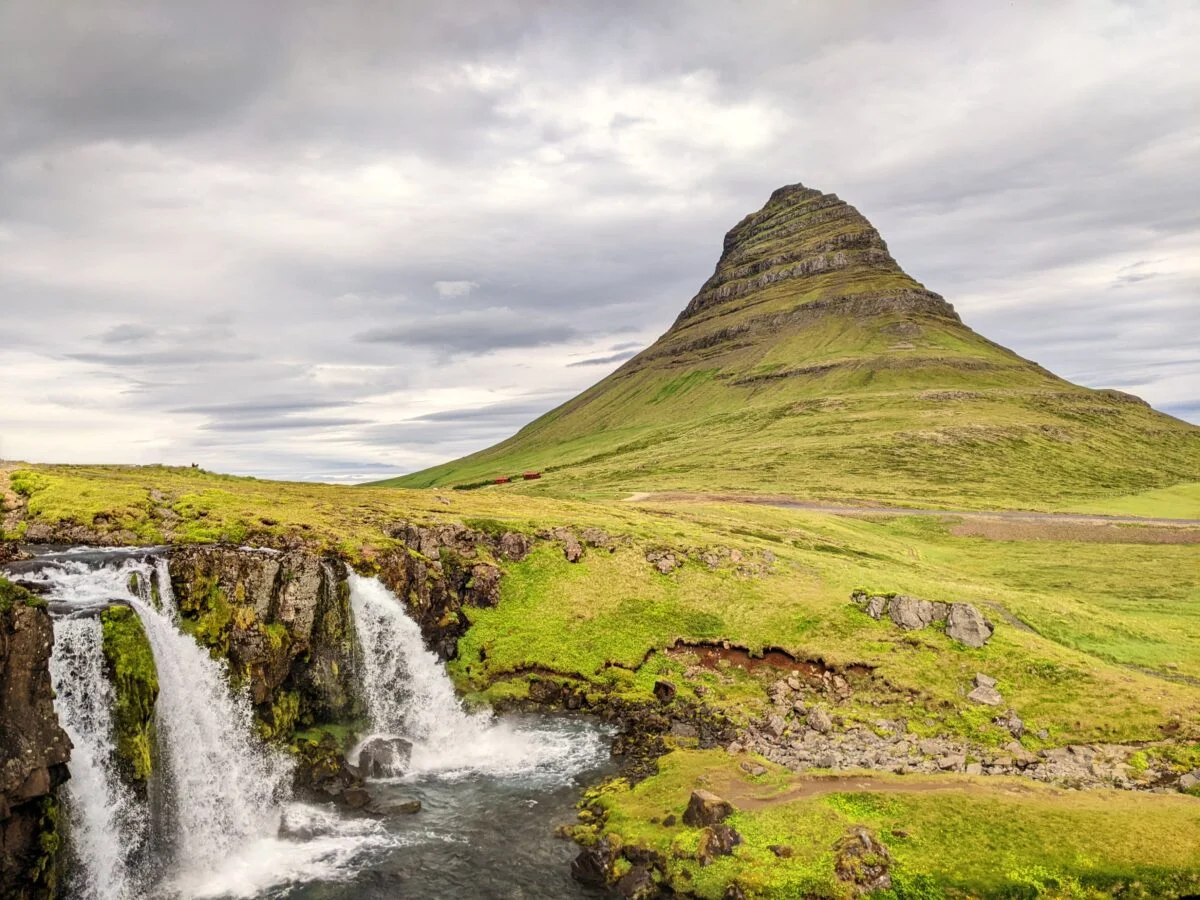
    In 2 weeks we visited many sites and we saw beautiful places. Impossible to miss waterfalls ( which are numerous), the most popular are Gullfoss, Godafoss and Skógafoss and the peculiar Seljalandsfoss, a waterfall where you can walk behind. Also beautiful are the cliffs and the volcanic beaches, the most famous is the black beach of Vik.
    As nature lovers, we hiked on canyons and walked in centennial woods, we visited ice caves and walked with ramps on a thousand-year- old glacial, the Vatnajökull. We navigate on a glacial lake and stroll on black beaches and we let ourselves amaze by the power of geysers. Climbing a volcano, we touched by hand a new layer of lava (obviously following the rules and safety instructions).
    We have seen puffins, whales and seals, we tried to imitate the locals dabbling Sprangan, the local sport of the Westman isles, without success!
    Then, after a busy day, we relaxed in geothermal baths. We chose to alternate to the modern wellness spa also basic baths, lost on fields in the middle of nowhere and managed by the landowners.
    We did not miss museums or sites of archaeological relevance.
    Of course, there are many more activities that can be done such as horse riding, kayaking, rafting, quad driving, etc. Hence, there is something to suit every taste.
    Visiting towns, that here are more like small villages, made us understand how local people live. Highly recommended is staying in a fishermen’s village, where, far from the modern capital Reykjavik, you can breathe the authentic Icelandic life. We did it in the beautiful Snaefellsnes peninsula.

    Iceland is an unusual destination for a holiday but I believe that is worth to visit it at least once in a lifetime. Its isolation from the other continents and its biodiversity make this island unique from all points of view.
    A trip to Iceland it’s an unforgettable experience.